Japan’s Moving Cost Trap: Why You Need 5 Months’ Rent Upfront
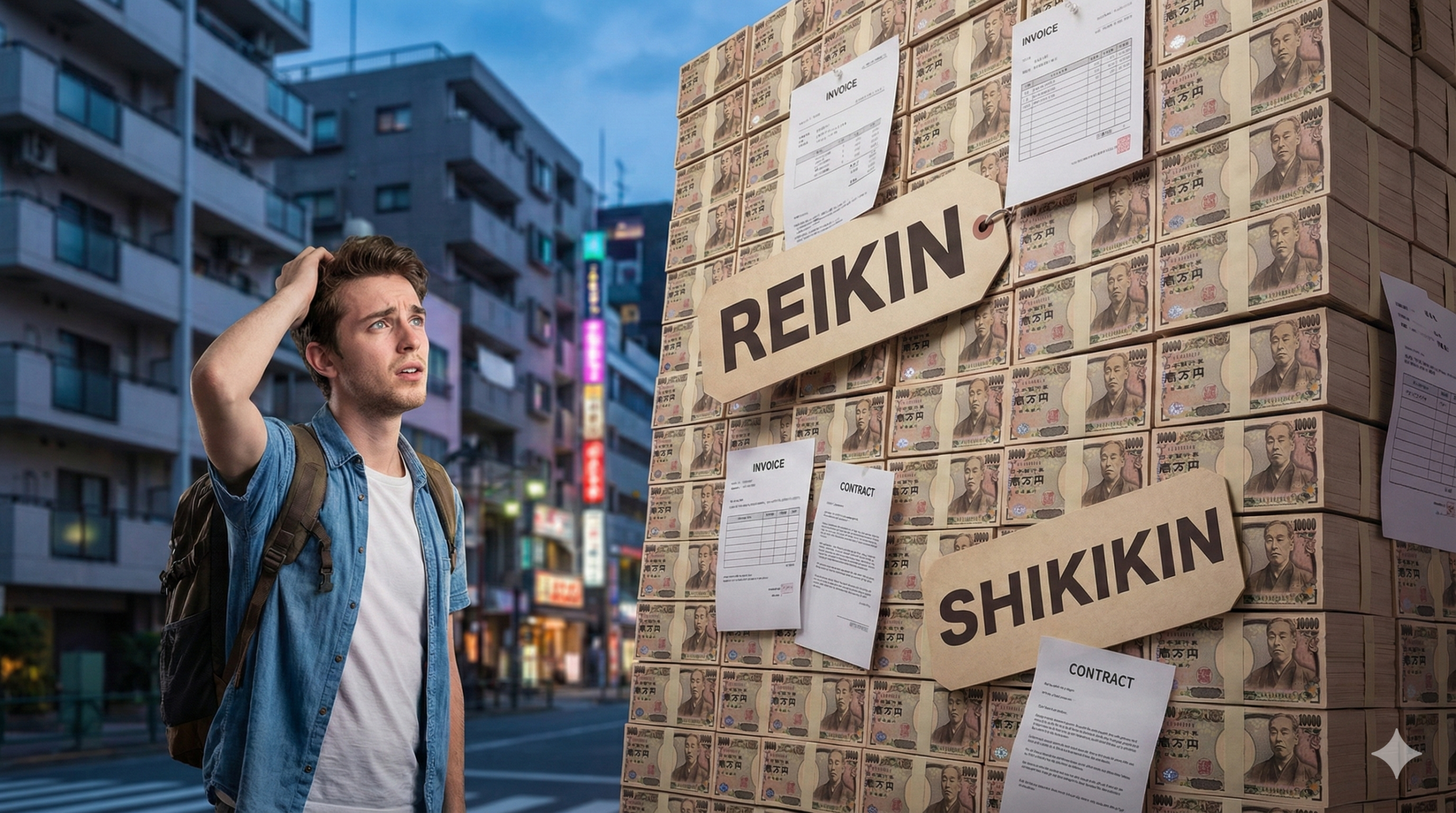
You found a perfect apartment in Tokyo listed for ¥80,000. You do the math: “Okay, first month’s rent plus a deposit… maybe ¥160,000 to move in?” You go to the real estate agent, and they hand you an estimate: ¥450,000.
Welcome to the “Shokishiyo” (Initial Cost) shock.
In most countries, moving costs are transparent. In Japan, they are a labyrinth of historical customs and hidden fees that can total 4 to 6 months of rent before you even spend a night in your new room. Here is the Reality of Japan regarding moving costs, the legal secrets agents won’t tell you, and how to survive without going broke.
1. The “Mystery Fees” Dictionary: Where Does Your Money Go?
Why is the initial cost so high? Let’s break down the traditional invoice.
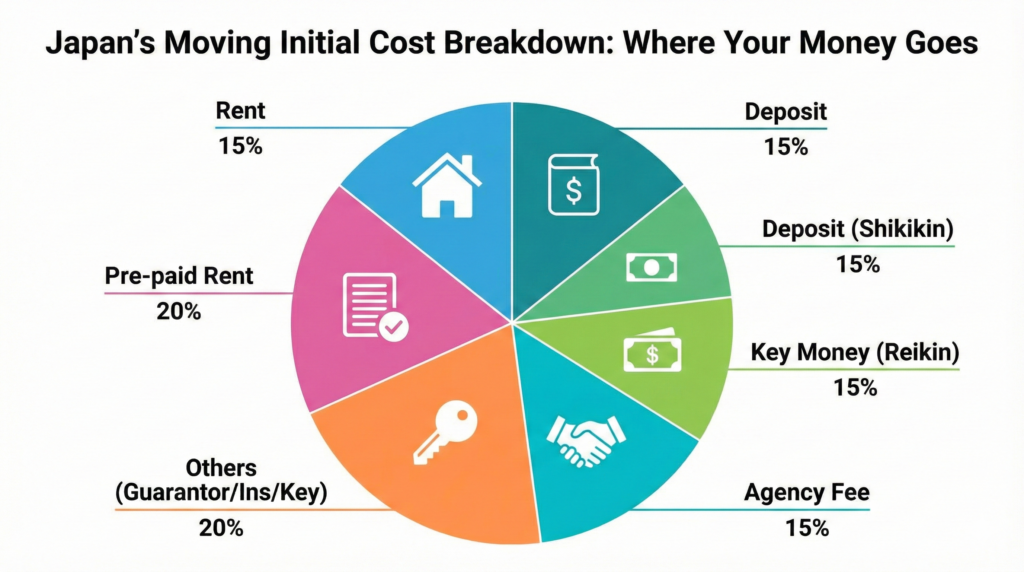
Reikin (Key Money) – The “Gratitude” Tax
- The Trap: You see a fee equal to 1 or 2 months’ rent called Reikin.
- The Reality: This translates to “Gratitude Money.” It is a mandatory gift to the landlord for “allowing” you to rent the place. You never get this back. It is a relic from the post-war era when housing was scarce.
- Cost: Usually 1 month’s rent (can be 2 for luxury/pet-friendly units).
Shikikin (Security Deposit)
- The Reality: This is the only fee that makes sense. It covers unpaid rent or damage.
- The Good News: You usually get some of this back when you move out, minus a “cleaning fee.”
- Cost: 1 month’s rent.
Hoshonin (Guarantor Company Fee)
- The Trap: “I have a Japanese friend who can be my guarantor!”
- The Reality: Most management companies today refuse personal guarantors. They force you to use a designated “Guarantor Company.” You are essentially paying for insurance to protect the landlord from you.
- Cost: 50% to 100% of one month’s rent (plus an annual renewal fee of ¥10,000).
2. The Brokerage Fee Secret: The “0.5 Month” Law
This is the biggest secret in the Japanese real estate industry.
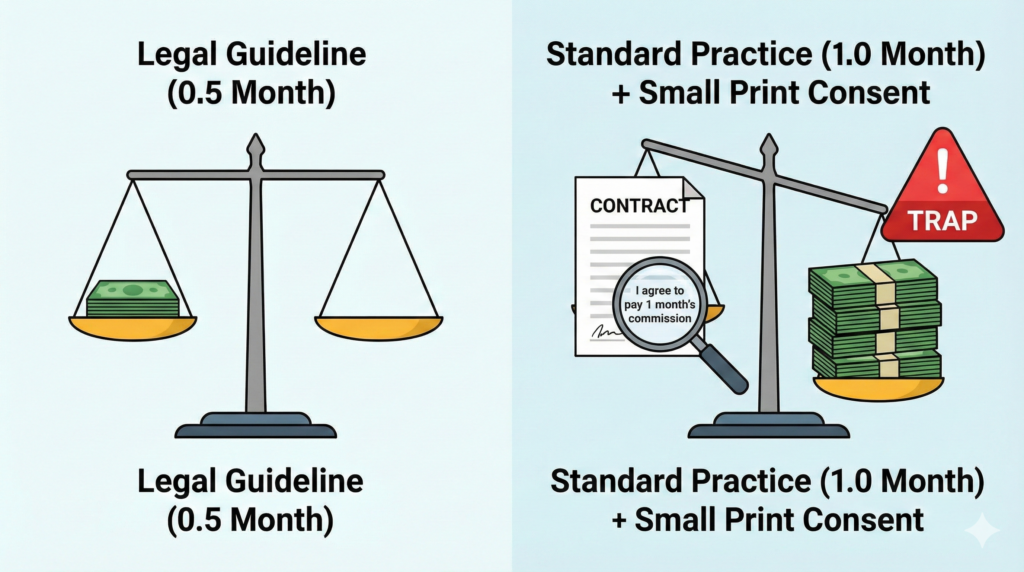
- The Trap: Almost every real estate agent charges 1 month’s rent + tax as a “Brokerage Fee” (Chukai-tesuryo). You assume this is the fixed legal rate.
- The Reality: According to the Ministry of Land, Infrastructure, Transport and Tourism (MLIT), the principle rule is that an agent cannot receive more than 0.5 months’ rent from the tenant (you) without your explicit consent.
- The Trick: So why does everyone pay 1 month? Because buried in the application documents you sign, there is a clause that says, “I agree to pay 1 month’s commission.” By signing, you waived your right to the 0.5 month rate.
- The Solution:
- Find “0.5 Month” Agents: Some modern agencies explicitly advertise “Half Brokerage Fee” (Tesuryo-hangaku).
- Negotiate Early: Before you sign anything or apply, ask: “I know the MLIT guideline is 0.5 months. Can we proceed with that?” (Note: Popular agents may refuse, but it is worth asking).
3. The Hidden Recurring Cost: “Koushin-ryo”
The trap doesn’t end when you move in.
- The Trap: You plan to live there for 4 years.
- The Reality: In the Kanto region (Tokyo/Kanagawa/Chiba/Saitama), most standard contracts are for 2 years. To extend the contract, you must pay a Renewal Fee (Koushin-ryo), usually equal to 1 month’s rent.
- It is essentially a penalty for being a loyal tenant.
4. Smart Solutions: How to Slash Costs by 50%
If you don’t want to pay ¥400,000+ to move into a ¥80,000 apartment, here are your alternatives.
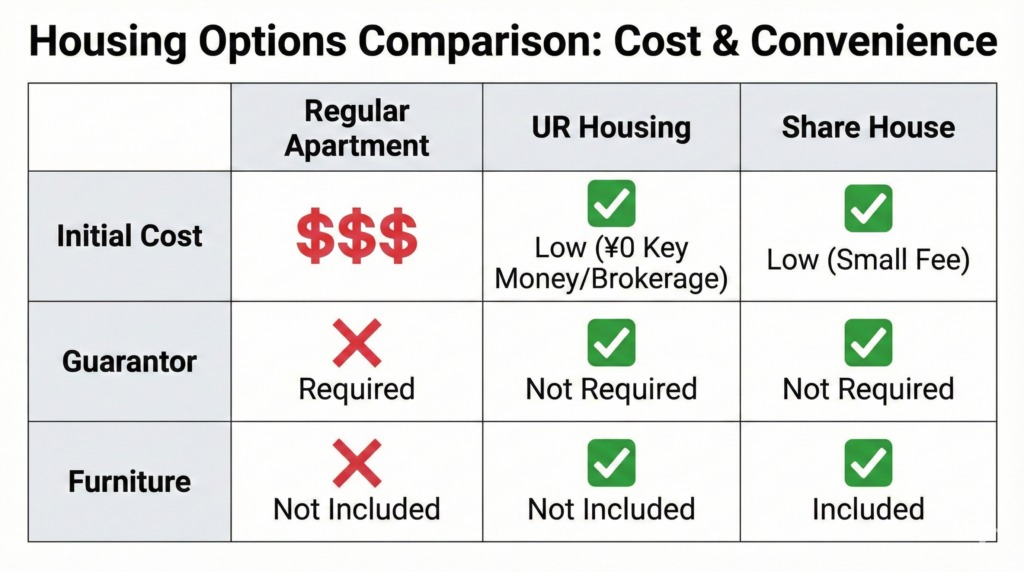
Option A: UR Housing (Urban Renaissance)
This is public housing managed by the government agency.
- Key Money: ¥0
- Brokerage Fee: ¥0
- Renewal Fee: ¥0
- Guarantor: Not required.
- The Catch: The competition is high, and some buildings are older. But for cost-performance, it is unbeatable.
Option B: Share Houses (Oakhouse, etc.)
Ideal for newcomers or those who want to save money and meet people.
- Initial Cost: Usually just a small contract fee (e.g., ¥30,000 – ¥50,000).
- Furniture: Included. (Saving you another ¥100,000).
- Utilities: Fixed rate (No surprise winter gas bills).
- Special Deal: Our partner Oakhouse offers high-quality social residences that are nothing like the cramped “gaijin houses” of the past.
- If you register via our link, you will receive 5,000 yen worth of points (PAO) to use for your rent!
Option C: Negotiate “Freerent”
If you must have a regular apartment, look for properties offering “Freerent” (1 month free rent). This effectively offsets the Brokerage Fee or Key Money. This is common during the “off-peak” seasons (May to August).
Conclusion: Don’t Sign Blindly
Japan is a wonderful place to live, but its rental system is designed to protect landlords, not tenants. When you see an apartment advertisement, mentally multiply the rent by 5. If you don’t have that cash ready, look for UR housing, Share Houses, or agencies that respect the 0.5-month rule.
What to do next?
- Check your budget: Use our [Salary Simulation Tool] to see if you can really afford that apartment after taxes.
- Browse Smart: Avoid the traps. Check [Oakhouse] for low-initial-cost options in Tokyo.