Foreign Media Says Japanese Politics is Easy. Is This Right?
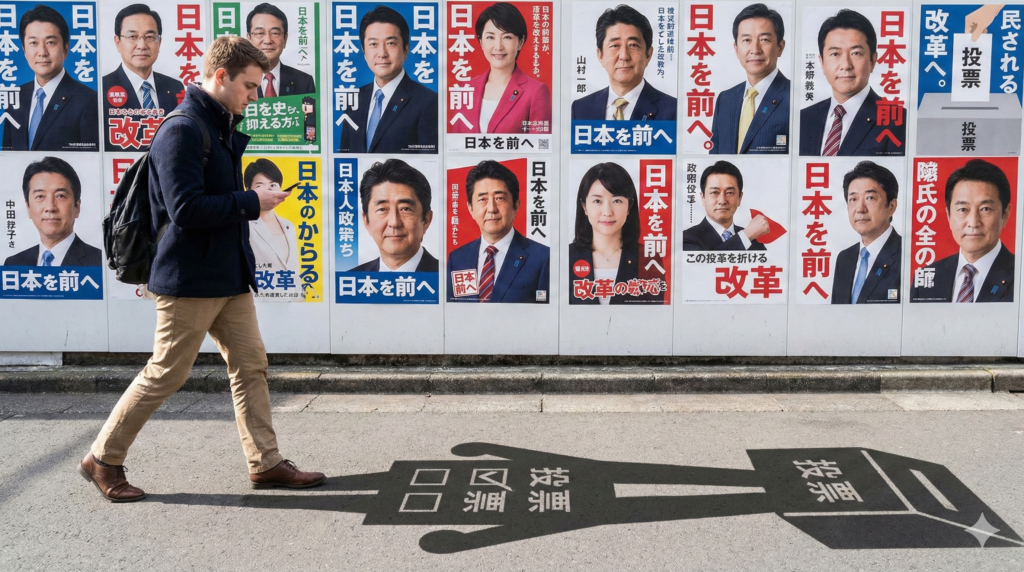
If you have ever experienced an election season in Japan, you know the ritual. White-gloved candidates stand atop small vans, repeating their names over loudspeakers with a deafeningly polite “Yoroshiku Onegaishimasu!” (Please support me!). To the uninitiated, it looks like a bizarre performance. To the cynical observer, it looks like a game with very simple rules.
A few years ago, The Times (UK) published a satirical piece with a biting headline: “How to win an election: speak clearly, say nothing.”
The article argued that in Japan, political victory does not come from debating policy details or engaging in ideological battles. Instead, it comes from purely aesthetic factors: smiling, waving, speaking with a crisp, clear voice, and—most importantly—avoiding any specific statements that might alienate a voter.
But is this satire actually true? Or is it just a Western oversimplification of a complex culture?
Following the February 2026 General Election, where Sanae Takaichi led the Liberal Democratic Party (LDP) to a historic landslide victory, we finally have a definitive answer. We analyzed the results to verify if the “Speak Clearly, Say Nothing” rule is still the golden ticket to power in Japan.
The Hypothesis: “Style Over Substance”
The core argument of the foreign media’s critique is that Japanese voters prioritize “Anshin” (peace of mind/reassurance) over “Kaikaku” (radical reform) or detailed policy debate.
According to this theory:
- Complexity is Fatal: A candidate who explains how they will fund a policy (e.g., “We need to raise taxes by 2%”) loses votes.
- Clarity is King: A candidate who simply states the outcome with confidence (e.g., “I will protect Japan!”) wins votes.
- The “Vibe” Vote: The electorate votes for the person who looks the most like a leader, regardless of what they actually say.
The Experiment: The Fall of the “Policy Geek”
To test this hypothesis, we first look at the brief and troubled tenure of the previous administration. Former Prime Minister Shigeru Ishiba was the antithesis of the “Say Nothing” rule. Known as a “policy otaku,” Ishiba often gave long, nuanced, and logically sound explanations for his decisions.
He spoke about the “severe security environment,” the “necessity of burden-sharing,” and the “complex realities of rural depopulation.” He spoke clearly, but he said too much. He burdened the voters with reality.
The result? His approval ratings plummeted. The public found his logic “gloomy” and his explanations “indecisive.” The electorate didn’t want a lecture; they wanted a leader. His failure set the stage for the perfect counter-experiment.
The Result: The “Queen of Clarity” Takes It All
Enter Sanae Takaichi. In the 2026 election, she executed the “The Times” strategy to perfection, proving the hypothesis correct.
As Japan’s first female Prime Minister, her campaign style was a masterclass in “High-Definition Ambiguity.”
- The Voice: As a former newscaster, her delivery was sharp, loud, and undeniably clear. Every syllable was designed to project strength.
- The Content: She focused almost entirely on broad, emotionally resonant slogans. “Make Japan Strong.” “Protect Our Sovereignty.” “Economic Growth First.”
- The “Nothing”: When pressed on specifically how she would fund her massive spending pledges without crashing the Yen or raising taxes, she offered vague assurances rather than math. She avoided the “unpleasant details” that doomed her predecessor.
The outcome was a landslide. The LDP, which had been struggling under Ishiba, roared back to a dominant majority. The voters didn’t care about the missing details. They rewarded the clarity of her performance.
The Verdict: The Satire Was Right
So, is the foreign media right? Yes.
The 2026 election proved that in the current Japanese political climate, “Speaking Clearly” is not just a bonus—it is the primary qualification for the job. The Japanese electorate, anxious about inflation and geopolitical instability, did not want to hear how the sausage is made. They just wanted someone to stand up and shout, with absolute conviction, that the sausage would be delicious.
For foreign residents living in Japan, this verification carries a warning. The “Easy” politics of Japan means that unpopular truths are often hidden until after the election. Takaichi won by “saying nothing” about the costs of her policies. Now that the election is over, the reality of those costs—likely in the form of social insurance hikes or currency fluctuations—will begin to surface.
The “Speak Clearly” phase is over. Now comes the part where the “Nothing” turns into “Something” that hits your wallet.